I skipped reading challenges in 2014. I was doing the challenge on Goodreads so didn't feel the need to do one here. Now I realize that I should do one and actually post book reviews here. I most likely will not review every book I read in 2015, and there are a number from 2014 I will want to review on this blog.
I've signed up for the 2015 Outdo Yourself Reading Challenge over at thebookvixen.com and will see how things go this time. According to Goodreads I read 62 books in 2014 - it was actually 63 since there was one that wasn't in Goodread's system. So for 2015 I'll try to read 64 books that are 100 or more pages (or equivalent). Rules for the challenge can be found HERE! I'll be signing up for the 'I’m on Fire!: read 16+ more books (or 4,000+ more pages)' level.
Any books I review on this blog related to this challenge will have the 2015 Reading Challenge tag. There are bound to be a few that will be better suited for review at my other blog, Othertimesblog.blogspot.com and in those cases I may create posts leading to the reviews on that blog.
Showing posts with label Books. Show all posts
Showing posts with label Books. Show all posts
01 January 2015

07 September 2014
13 of the top 10 books that stuck with me
I've been tagged me with the challenge of listing the 10 books that have stayed with me. I read a lot of books every year so the list would be very long. I'm sure I've forgotten some important ones that should be included, but I'm already over my limit. Given my natural generosity and disdain for rules I'll be giving a list of 13 instead of 10:
1) AD&D Player's Handbook (1st edition) – by Gary Gygax: This probably had the most influence on me overall, the others will be in no particular order.
2) Tarzan Alive – by Philip Jose Farmer: Farmer is one of my favorite authors. While the first of his books I read were in the Riverworld series Tarzan Alive helped increase my interest in his works and the concept of the Wold Newton Universe.
3) How to Start Your Own Country – by Erwin S. Strauss: A great book on micronation. I've been hooked on the topic ever since. 4) The Art of War – by Sun Tzu
5) A Princess of Mars – by Edgar Rice Burroughs: This one covers all of Burroughs works and my general love of old pulps.
6) For Want of a Nail – by Robert Sobel: My introduction into the area of alternate history. Written as an actual history book from that alternate timeline. I've now read a multitue of alt history books and even have a blog on the topic.
7) The Pity of War – by Niall Ferguson: World War I is a topic I've read dozens of books on. There are so many good ones. This one isn't the best, but it is very good and did get me thinking about things a little differently.
8) Of the City of the Saved – by Philip Purser-Hallard: One of my favorite books in the Faction Paradox series. Faction Paradox is what Doctor Who could be if they got some really creative people working on it.
9) The Crying of Lot 49 – by Thomas Pynchon: Equal parts bizarre and awesome. Also has the kind of ending I love and tends to annoy many others.
10) Physics of the Future – by Michio Kaku: One of my favorite books from my favorite scientist.
11) In the Country of the Blind – by Michael Flynn: A book filled with interesting characters, conspiracies, and great supplemental material in the back. Winner of the 1991 Prometheus Award.
12) 1632 – by Eric Flint: In 2000 a West Virginian mining town is transported to the middle of the Thirty Years War. Amazing start to a large series.
13) The Seychelles Affair – by Mike Hoare: I like Mike's various memoirs and articles especially about his experiences in the Congo. This book covers a failed operation and time in a South African prison. Some insights in this one not in his other books.
As for challenging anyone else to listing their top 10 books - I challenge anyone who actually feels like doing so.
1) AD&D Player's Handbook (1st edition) – by Gary Gygax: This probably had the most influence on me overall, the others will be in no particular order.
2) Tarzan Alive – by Philip Jose Farmer: Farmer is one of my favorite authors. While the first of his books I read were in the Riverworld series Tarzan Alive helped increase my interest in his works and the concept of the Wold Newton Universe.
3) How to Start Your Own Country – by Erwin S. Strauss: A great book on micronation. I've been hooked on the topic ever since. 4) The Art of War – by Sun Tzu
5) A Princess of Mars – by Edgar Rice Burroughs: This one covers all of Burroughs works and my general love of old pulps.
6) For Want of a Nail – by Robert Sobel: My introduction into the area of alternate history. Written as an actual history book from that alternate timeline. I've now read a multitue of alt history books and even have a blog on the topic.
7) The Pity of War – by Niall Ferguson: World War I is a topic I've read dozens of books on. There are so many good ones. This one isn't the best, but it is very good and did get me thinking about things a little differently.
8) Of the City of the Saved – by Philip Purser-Hallard: One of my favorite books in the Faction Paradox series. Faction Paradox is what Doctor Who could be if they got some really creative people working on it.
9) The Crying of Lot 49 – by Thomas Pynchon: Equal parts bizarre and awesome. Also has the kind of ending I love and tends to annoy many others.
10) Physics of the Future – by Michio Kaku: One of my favorite books from my favorite scientist.
11) In the Country of the Blind – by Michael Flynn: A book filled with interesting characters, conspiracies, and great supplemental material in the back. Winner of the 1991 Prometheus Award.
12) 1632 – by Eric Flint: In 2000 a West Virginian mining town is transported to the middle of the Thirty Years War. Amazing start to a large series.
13) The Seychelles Affair – by Mike Hoare: I like Mike's various memoirs and articles especially about his experiences in the Congo. This book covers a failed operation and time in a South African prison. Some insights in this one not in his other books.
As for challenging anyone else to listing their top 10 books - I challenge anyone who actually feels like doing so.
22 July 2013
Book Review - Harry Sullivan's War

Harry Sullivan was one of the companions of the Fourth Doctor Who (the Doctor with the scarf). He worked with the Doctor and U.N.I.T. on a number of adventures. In 1986 he finally got his own book - written by Ian Marter, the actor who played Harry on the show!
Ian Marter wrote a number of the novelizations of the old Doctor Who episodes. I've read his novelization of the Enemy of the World story since I'm a fan of the second Doctor and that story was incomplete in its original format. For this story Ian gets to create an original tale - one that does not have the time lord making an appearance.
THE STORY
It has been a decade since Harry last adventured in the TARDIS. He has left U.N.I.T. and has recently been transferred to a NATO research facility that develops chemical weapons. Harry is involved mostly on the antidote side of the research. As he begins working at his new position in a facility up in Scotland strange things begin to happen to him, including attempts on his life. Instead of notifying his superiors of the attempts he sets out to unravel things on his own.
Before long Harry is on the run from a terrorist group as well as from his own government which now suspects he is the actual spy. There are long chases across Scotland and into London itself. At times it seemed like I was reading a John Buchan book..... at least until Harry would say something stupid like "Oh my giddy aunt!" Hard to picture an action hero constantly using a line like that. Harry is also completely clueless - it goes beyond the expected amount of ignorance involved for a mystery, but he has such limited information about what is going on there is no reason for him to not immediately call his superiors.
I have trouble figuring out the exact motives of the villains. After spending time trying to murder our hero they then go to great pains to capture and imprison him. I'm not sure exactly what they wanted with the nerve agents they stole... I think the bad guys had a bit of a falling out as one faction became more violent than the original group. The group also used paintings by Van Gogh as a symbol of their organization.
Harry was way too gullible to the manipulations of the femme fatale of the story. He has a couple of encounters with Sarah Jane Smith as well, but they seem to be just 'friends'.
The ending was a bit confusing and involved a fight around the superstructure of the Eiffel Tower that might of looked good in a James Bond film of that era. Again, there is no reason for Harry to be anywhere near the villains at the end, it was a job for the British Secret Service. And despite how idiotic Harry could be at times the villains are even dafter as they follow through with their meeting in Paris after all that happened in the book.
CONCLUSION
Overall I liked the book. While it failed in may ways to be a good thriller and the story was confusing there was an enthusiastic energy that made it fun. It is also nice to see something in the Doctor Who universe that doesn't revolve around the alien-of-the-week trying to destroy or dominate the Earth. Big thumbs up for not creating a story involving that. It was a nice attempt to expand the universe and add elements from genres not normally associated with Doctor Who.
There were too many questions at the end. What about the potential medical discovery Harry made? What was the Brigadier actually doing in the villain's hideout? What about his friend's wife - was she involved in the conspiracy? What was really going on?
If you are a big Doctor Who fan it is worth the read. If you just want a thriller novel set in Britain then you might want to try The 39 Steps, or the Power-House instead, you'll most likely be disappointed with the action in this novel.
21 March 2013
Third Sentence Thursday - The Mad Goblin

Make your own banner at MyBannerMaker.com!
1) Take the book you are currently reading and open it to a random page. Share the third full sentence on that page. (If there isn’t a third one – like at the end of a chapter or a blank page – you can share the third sentence of the book or just choose another random page.) Feel free to share more than one sentence, if you feel the need to do so.
2) Review this sentence anyway you want (funny and silly reviews encouraged)
3) Post a link to your sentence at Words I Write Crazy
4) Visit one or two of the other blogs to check out their third sentences!
"It was a lizardlike reptile with a long slim snakelike body about five and a half feet long." from The Mad Goblin by Philip José Farmer
So far this has been a great adventure story. One of the sequels to A Feast Unknown.
19 March 2013
Top 10 books I just had to buy but still haven't read
I've decided to give this meme a try. It might motivate me to actually read one of these books.

Meme form brokeandbookish.blogspot.com
To be fair a number of these are Kindle versions but they were all impulse buys nonetheless:
1. Radicals for Capitalism by Brian Doherty - I want to read this... it's just a very long book and I let too many things distract me.
2. The Restoration Game by Ken MacLeod - a nominee for the Prometheus Award. I was trying to read all of the nominees that year... didn't make it.
3. Dreadnought by Robert K. Massie - another big book on World War I. While I've read dozens of books on the war I've always favored reading about aircraft or the more obscure fronts of the war. I've been ignoring the Dreadnoughts for too long.
4. The Political Philosophy of Bakunin edited by G.P. Maximoff - It can be interesting to read about early anarchists and revolutionaries and comparing them to the ones we have today. Bakunin was going to be a project for me a few years ago.... a project that still needs to be finished.
5. The Seychelles Affair by Mike Hoare - Hoare's memoirs of the botched invasion of the Seychelles.
6. Tolkien and the Great War by John Garth - The Great War and J.R.R. Tolkien; how have I ignored this on for so long?
7. The Entrepreneur's Guide to Second Life by Daniel Terdiman - Years ago I considered trying out Second Life. It even has its own currency that can be exchanged with US Dollars. Never followed through, and even today doesn't seem like a good use of my time.
8. A Day in the Life of Ancient Rome by Alberto Angela - Bought this one for a role-playing game campaign I was running set in ancient Rome. Game lasted two sessions book remained unread.
9. Scapegoats of the Empire by George Witton - the memoirs of an Australian officer run through a British military kangaroo court during the Boer War. Basis for the movie Breaker Morant. Love the movie, not sure if I need to read the book.
10. Tales of the Far West by various authors - An anthology of short stories for the Far West role-playing game setting. Looks like an awesome setting, just have to find time to read this someday.
I have to take some of the one on this list that are physical books and either trade them on Paperback Swap (where I'll just get credits for other books I won't read) or I'll have to donate them to one of the local libraries. Might end up being the library since I now take better advantage of the books they store on their shelves so I don't have to. Got through a few books recently (one I have to return by the end of this week) and it didn't cost me a dime. Before going into a bookstore be sure to intentionally look at your library card or keep it on top of your credit card - it can save you a lot of money in the long run!
Meme form brokeandbookish.blogspot.com
To be fair a number of these are Kindle versions but they were all impulse buys nonetheless:
1. Radicals for Capitalism by Brian Doherty - I want to read this... it's just a very long book and I let too many things distract me.
2. The Restoration Game by Ken MacLeod - a nominee for the Prometheus Award. I was trying to read all of the nominees that year... didn't make it.
3. Dreadnought by Robert K. Massie - another big book on World War I. While I've read dozens of books on the war I've always favored reading about aircraft or the more obscure fronts of the war. I've been ignoring the Dreadnoughts for too long.
4. The Political Philosophy of Bakunin edited by G.P. Maximoff - It can be interesting to read about early anarchists and revolutionaries and comparing them to the ones we have today. Bakunin was going to be a project for me a few years ago.... a project that still needs to be finished.
5. The Seychelles Affair by Mike Hoare - Hoare's memoirs of the botched invasion of the Seychelles.
6. Tolkien and the Great War by John Garth - The Great War and J.R.R. Tolkien; how have I ignored this on for so long?
7. The Entrepreneur's Guide to Second Life by Daniel Terdiman - Years ago I considered trying out Second Life. It even has its own currency that can be exchanged with US Dollars. Never followed through, and even today doesn't seem like a good use of my time.
8. A Day in the Life of Ancient Rome by Alberto Angela - Bought this one for a role-playing game campaign I was running set in ancient Rome. Game lasted two sessions book remained unread.
9. Scapegoats of the Empire by George Witton - the memoirs of an Australian officer run through a British military kangaroo court during the Boer War. Basis for the movie Breaker Morant. Love the movie, not sure if I need to read the book.
10. Tales of the Far West by various authors - An anthology of short stories for the Far West role-playing game setting. Looks like an awesome setting, just have to find time to read this someday.
I have to take some of the one on this list that are physical books and either trade them on Paperback Swap (where I'll just get credits for other books I won't read) or I'll have to donate them to one of the local libraries. Might end up being the library since I now take better advantage of the books they store on their shelves so I don't have to. Got through a few books recently (one I have to return by the end of this week) and it didn't cost me a dime. Before going into a bookstore be sure to intentionally look at your library card or keep it on top of your credit card - it can save you a lot of money in the long run!
15 January 2013
Book Review: My Ideal Bookshelf
At the end of last year I won a copy of My Ideal Bookshelf from a giveaway on Goodreads. I've finished reading it and here is my review:
My Ideal Bookshelf was edited by Thessaly La Force and was filled with art by Jane Mount. Over a hundred people wrote about their ideal book shelves, filling a page with their thoughts. Across from each essay is one of Jane's paintings of that particular person's 'ideal bookshelf.' I have to admit that most of the people who participated were unknown to me, but I did know of a few of them beforehand.
One page to describe about ten books and why they were chosen to be on that person's ideal bookshelf is not much space. Many didn't cover all of the books illustrated for their shelves. At first I didn't like that - I thought that they should at least explain why each of books were chosen to be on their top list. However, as I made my way through the book I realized that the essays were fine the way they were. They had to be kept to one page, more than that would have spoiled the nice layout of the book. In some cases the best essays were the ones that didn't even describe any of the books on that particular shelf but instead described the general thoughts the person had on books in general.
If I reviewed this book after only reading the first fifty pages I might of only given it two out of five stars, but as I reached the end I 'got it' and began to really like the book. It was also nice on those occasions when I spotted a book that was on one of my shelves. My final review of this book is 4 out of 5 stars.
MY IDEAL BOOKSHELF

Here is my sketch of the ten books that I would put in my 'Ideal Bookshelf' as of January 2013. Included on that shelf are the following:
Advanced Dungeons & Dragons Players Handbook: by Gary Gygax. Dungeons & Dragons had a big influence on my early life. This well-worn tome had to make the list.
Myths of the Modern Age: by Win Scott Eckert. A series of articles and essays about the Wold Newton concept. One of my favorite recent things.
Guns, Germs, and Steel: by Jared Diamond. A great reference that aided me in developing various alternate timelines for some role-playing games.
For Want of a Nail: by Robert Sobel. An awesome alternate history that was written as if it were an actual history book form that alternate world.
Recarving Rushmore: by Ivan Eland. A very good analysis of the Presidents of the United States from a completely different set of parameters than most other rankings.
The Martian Tales Trilogy: by Edgar Rice Burroughs. Classic sword & planet.
How to Start Your Own Country: by Erwin S. Strauss. Great reference book for micronations
The Pity of War: by Niall Ferguson. One of the better books on the First World War in recent years.
The Crying of Lot 49: by Thomas Pynchon. Just the right amount of strangeness for my tastes.
The Guns of the South: by Harry Turtledove. A great story about time travel and the American Civil War.
My Ideal Bookshelf was edited by Thessaly La Force and was filled with art by Jane Mount. Over a hundred people wrote about their ideal book shelves, filling a page with their thoughts. Across from each essay is one of Jane's paintings of that particular person's 'ideal bookshelf.' I have to admit that most of the people who participated were unknown to me, but I did know of a few of them beforehand.
One page to describe about ten books and why they were chosen to be on that person's ideal bookshelf is not much space. Many didn't cover all of the books illustrated for their shelves. At first I didn't like that - I thought that they should at least explain why each of books were chosen to be on their top list. However, as I made my way through the book I realized that the essays were fine the way they were. They had to be kept to one page, more than that would have spoiled the nice layout of the book. In some cases the best essays were the ones that didn't even describe any of the books on that particular shelf but instead described the general thoughts the person had on books in general.
If I reviewed this book after only reading the first fifty pages I might of only given it two out of five stars, but as I reached the end I 'got it' and began to really like the book. It was also nice on those occasions when I spotted a book that was on one of my shelves. My final review of this book is 4 out of 5 stars.

Here is my sketch of the ten books that I would put in my 'Ideal Bookshelf' as of January 2013. Included on that shelf are the following:
Advanced Dungeons & Dragons Players Handbook: by Gary Gygax. Dungeons & Dragons had a big influence on my early life. This well-worn tome had to make the list.
Myths of the Modern Age: by Win Scott Eckert. A series of articles and essays about the Wold Newton concept. One of my favorite recent things.
Guns, Germs, and Steel: by Jared Diamond. A great reference that aided me in developing various alternate timelines for some role-playing games.
For Want of a Nail: by Robert Sobel. An awesome alternate history that was written as if it were an actual history book form that alternate world.
Recarving Rushmore: by Ivan Eland. A very good analysis of the Presidents of the United States from a completely different set of parameters than most other rankings.
The Martian Tales Trilogy: by Edgar Rice Burroughs. Classic sword & planet.
How to Start Your Own Country: by Erwin S. Strauss. Great reference book for micronations
The Pity of War: by Niall Ferguson. One of the better books on the First World War in recent years.
The Crying of Lot 49: by Thomas Pynchon. Just the right amount of strangeness for my tastes.
The Guns of the South: by Harry Turtledove. A great story about time travel and the American Civil War.
26 April 2012
Third Sentence Thursday - Underground Warfare 1914-1918

2. Share your thoughts on the sentence (or sentences).
3. Post a link on Proud Book Nerd's Third Sentence for the week by clicking on the image above.
4. Visit one or two of the other blogs to check out their third sentence(s).
"He also asked that new units be recruited from the class of 1915, which need not be trained in the full range of field engineering, but only in sapping and mining." (from Underground Warfare 1914-1918 by Simon Jones (p.36)
Both sides were unprepared for the type of war that would develop. Little training had been given to sapping and mining in the years prior to the Great War, is was assumed that it would be a war of mobility. It quickly became apparent that the old skills would still be needed, and by the end of the war they would be greatly refined and many new developments in underground warfare would take place. French General Foch realized the need for sappers and made this request regarding the class of 1915.
18 April 2012
Book Review - The Crying of Lot 49
Tax season is finally over. Time to get back to a more regular blogging schedule. Not only my blogging has been neglected in recent weeks, but my reading time as well. I have finished The Crying of Lot 49, by Thomas Pynchon. I've written up this short review, which was mildly difficult. It is a bizarre story and I wanted to be sure not to put any real spoilers in it. So here's what I came up with.

(image from Amazon.com)
THE STORY
Oedipa Maas is made executor of an ex-boyfriend's estate. She uncovers the secret history of a mysterious group called W.A.S.T.E. and the Trystero family which operates an underground postal service for those who don't want to use the government postal monopoly.
During her journey Oedipa encounters a large number of eccentric and strangely named characters. She begins to piece together the secret history of the group and its attempts to overcome the postal monopoly of Thurn und Taxis in 16th & 17th century central Europe. Things begin to get more bizarre and then people start to die or change. Her psychiatrist goes insane, her husband's personality alters, and many people who might know something about Trystero die or stop talking with her.
Towards the end of the story Oedipa can't even be sure that this whole scenario isn't an elaborate prank by her dead ex-boyfriend. He had vast amounts of money and resources and might have set up the whole situation to torture her. As the estate assets begin to be disposed over a group of W.A.S.T.E. stamps are to be auctioned off as lot 49 and a bidder who Oedipa believes is a member of Trystero will be in attendance to make sure the stamps don't fall into the wrong hands. She will finally have a chance to confront one of the higher ups in the secret organization. She just has to wait for the crying of lot 49.
THE GOOD
While bizarre the story was very interesting. Interesting and obscure bits of real history tied together with fictional connections and events. A strange stage play described in detail which gives Oedipa some of her clues. I even got a number of the more obscure references; I'm going to have to read it again at some point to try to find the stuff I missed. Truly a product of the 1960s.
THE BAD
Nothing really bad about this book. It can be confusing at times but since the main character is confused it helps the reader identify with her more, if that makes any sense. The ending is similar to endings in some stories I've written for a writing group I belong to, it's a type of ending that might annoy some people.
QUOTE
There are a lot of good quotes that could be pulled out of this book. There is a scene later in the book where Oedipa thinks she is going crazy over this whole conspiracy. She visits here shrink, Dr. Hilarius.... just as he has gone insane himself. She tells him that she was hoping he would talk her out of her fantasy and he responds:
"Cherish it! What else do any of you have? Hold it tightly by its little tentacle, don't let the Freudians coax it away or the pharmacists poison it out of you. Whatever it is, hold it dear, for when you lose it you go over that much more to the others. You begin to cease to be." (page 103)
OVERALL
I loved this book.
PUBLISHER: Bantam Book
AUTHOR: Thomas Pynchon
GENRE: bizarre, mystery
PAGE COUNT: 138
ISBN: 553-05764-095
2012 CHALLENGES: 150+ Reading Challenge 2012, A-Z Challenge

Oedipa Maas is made executor of an ex-boyfriend's estate. She uncovers the secret history of a mysterious group called W.A.S.T.E. and the Trystero family which operates an underground postal service for those who don't want to use the government postal monopoly.
During her journey Oedipa encounters a large number of eccentric and strangely named characters. She begins to piece together the secret history of the group and its attempts to overcome the postal monopoly of Thurn und Taxis in 16th & 17th century central Europe. Things begin to get more bizarre and then people start to die or change. Her psychiatrist goes insane, her husband's personality alters, and many people who might know something about Trystero die or stop talking with her.
Towards the end of the story Oedipa can't even be sure that this whole scenario isn't an elaborate prank by her dead ex-boyfriend. He had vast amounts of money and resources and might have set up the whole situation to torture her. As the estate assets begin to be disposed over a group of W.A.S.T.E. stamps are to be auctioned off as lot 49 and a bidder who Oedipa believes is a member of Trystero will be in attendance to make sure the stamps don't fall into the wrong hands. She will finally have a chance to confront one of the higher ups in the secret organization. She just has to wait for the crying of lot 49.
THE GOOD
While bizarre the story was very interesting. Interesting and obscure bits of real history tied together with fictional connections and events. A strange stage play described in detail which gives Oedipa some of her clues. I even got a number of the more obscure references; I'm going to have to read it again at some point to try to find the stuff I missed. Truly a product of the 1960s.
THE BAD
Nothing really bad about this book. It can be confusing at times but since the main character is confused it helps the reader identify with her more, if that makes any sense. The ending is similar to endings in some stories I've written for a writing group I belong to, it's a type of ending that might annoy some people.
QUOTE
There are a lot of good quotes that could be pulled out of this book. There is a scene later in the book where Oedipa thinks she is going crazy over this whole conspiracy. She visits here shrink, Dr. Hilarius.... just as he has gone insane himself. She tells him that she was hoping he would talk her out of her fantasy and he responds:
"Cherish it! What else do any of you have? Hold it tightly by its little tentacle, don't let the Freudians coax it away or the pharmacists poison it out of you. Whatever it is, hold it dear, for when you lose it you go over that much more to the others. You begin to cease to be." (page 103)
OVERALL
I loved this book.
PUBLISHER: Bantam Book
AUTHOR: Thomas Pynchon
GENRE: bizarre, mystery
PAGE COUNT: 138
ISBN: 553-05764-095
2012 CHALLENGES: 150+ Reading Challenge 2012, A-Z Challenge
01 March 2012
Third Sentence Thursday - The Red Baron
2. Share your thoughts on the sentence (or sentences).
3. Post a link on Proud Book Nerd's Third Sentence for the week by clicking on the image above.
4. Visit one or two of the other blogs to check out their third sentence(s).
"Therefore, it never occurred to me to become a pilot." (from The Red Baron by Manfred von Richtofen (p.63)
An interesting quote from the greatest fighter ace of the First World War. Of course in context it was early in the war, he was recently transferred from the cavalry to become an observer in a two-seater aircraft. At that point he felt that in the time it would take him to train to become a pilot the war would be over.
19 February 2012
Review - Tarzan at Earth's Core

THE STORY Tarzan gets hired by an American, Jason Gridley, for an expedition to find the legendary polar opening to the inner world of Pellucidar. Gridley had learned that David Innes, the Emperor of Pellucidar, has been captured by enemies in that world and is in need of rescue.
An incredible airship is constructed. Tarzan and Gridley lead an expedition of specialists to find the opening to the Earth's core and rescue Innes. The airship manages to find the opening and descends into the Earth.
In the core things are very different than on the outer crust. A central sun provides light across Pellucidar, but gives the illusion that it is constantly noon. There is no night in Pellucidar. Navigation is also difficult, even looking for mountains as landmarks can be tricky since the horizon curves up and this creates tricks that men from the outer world have trouble compensating for.
Then there are the animals that have been long extinct on the surface. Dinosaurs, sabertooth tigers, and other prehistoric beasts dominate much of this new land.
After the airship lands Tarzan becomes lost and expeditions are sent out to find him. Many of these also become lost and things begin to look hopeless. Gridley even comes across a primitive yet beautiful princess who he falls in love with but manages to accidentally offend because of their different cultures (a standard storyline in many of Burroughs' books).
In the end incredibly lucky (or contrived) circumstances bring all of the various storylines to a successful and happy conclusion.
THE GOOD Tarzan and dinosaurs. Doesn't get much better than that. Fairly standard Burroughs story so if you like his other works you should love this one. Quick and easy read. Early on it also shows that Tarzan is highly intelligent, including about scientific matters. This is often overlooked by people since they think that since he was raised by apes he has to be some sort of idiot. Tarzan taught himself how to read - only a true genius could manage such a feat.
THE BAD The contrived and predictable situations. I know that convenient events are sometimes needed, especially in adventure stories, but they can many times border on unbelievable and could possibly threaten to ruin an otherwise good story.
The ending also seemed a bit rushed.
OVERALL A solid offering in the Tarzan series. It also ties the Tarzan and Pelluciar series together. Recommended for those who want a quick and entertaining story.
PUBLISHER: Ballantine Books
AUTHOR: Edgar Rice Burroughs
GENRE: Science Fiction, pulp adventure
PAGE COUNT: 191
ISBN: 345-24483-4-125
2012 CHALLENGES: 150+ Reading Challenge 2012, 2012 Read 52 Books in 52 weeks, 2012 TBR Pile Reading Challenge
11 February 2012
2012 Book Haul
Recently I sold about 48 DVDs via Amazon Trade-In. Ended up getting about $68 in credit for them. It may not seem like that good of a deal, selling DVDs I originally paid nearly $500 for at such a low price. But a number of the DVDs were old and most I hadn't watched in a couple years. Amazon will make money off them and I cleared out shelf space and was able to buy some books I've wanted for some time. A win-win situation.
I ended up clearing some of the books off my want list. Nine of them in all. A wide variety of topics from science fiction, graphic novels, and pulp fiction to anthropology, history, and political science. A very interesting haul, and possibly the only “book haul” I'll manage this year. Total postage for all of these was about $35.55; more than half of the amount I traded the DVDs in for.

Doctor Omega: by Arnould Galopin. A French sci-fi novel from 1905 translated to English. Unfortunately it has been “modernized” a bit in the process of translation. Possible inspiration for Doctor Who.
The Ayn Rand Lexicon: edited by Harry Binswanger. Looks like this will be a great reference guide to learning more about Rand's philosophy. I'm not really an Objectivist but want to learn more about them.
Adventure volume one: edited by Chris Roberson. Well over a dozen new pulp-style stories by about seventeen different authors. This promises to be very good, and was much larger than I anticipated. Overall I'm usually very happy with Monkeybrain Books.
The Political Philosophy of Bakunin: by G.P. Maximoff. I know a little about Bakunin. I want to read some of his writings to see if my picture of him is correct. Even if my initial perceptions of him are wrong I'm sure he's still a better man than Marx.
Road Belong Cargo: by Peter Lawrence. An anthropological study of the Cargo Cults of New Guinea. Has a bit of underlining and highlighting. Looks like it may be an ex-college book. Looking forward to reading it; I've always wanted to learn more about the Cargo Cults.
The Seychelles Affair: by Mike Hoare. The story of Hoare's failed attempt to liberate the Seychelles after being hired by its government in exile. I've read some magazine articles on the subject, it'll be nice to read the memoirs of the man in charge of that operation.
The Kingdom: Graphic novel by DC Comics. A sequel to the awesome Kingdom Come series. While not nearly as good as the original I do remember the stories begin entertaining.
Gold & Iron: by Fritz Stern. A study of the relationship between Bismarck and Gerson von Bleichroder and how it influenced the rise of the German nation. Hopefully there will be some useful insights in this book. Some very light pencil underlining and a little stained but good binding.
Pearls from Peoria: by Philip José Farmer. A large collection of short stories by Farmer. This book is huge; about 770 pages or so. It is an ex-library book but in pretty good shape considering that.
The biggest problem I have now is to decide which of these to read first. And since they are new acquisitions for me they won't count for my TBR Pile reading challenges for this year. Well, there are far worse problems to have.

I ended up clearing some of the books off my want list. Nine of them in all. A wide variety of topics from science fiction, graphic novels, and pulp fiction to anthropology, history, and political science. A very interesting haul, and possibly the only “book haul” I'll manage this year. Total postage for all of these was about $35.55; more than half of the amount I traded the DVDs in for.

Doctor Omega: by Arnould Galopin. A French sci-fi novel from 1905 translated to English. Unfortunately it has been “modernized” a bit in the process of translation. Possible inspiration for Doctor Who.
The Ayn Rand Lexicon: edited by Harry Binswanger. Looks like this will be a great reference guide to learning more about Rand's philosophy. I'm not really an Objectivist but want to learn more about them.
Adventure volume one: edited by Chris Roberson. Well over a dozen new pulp-style stories by about seventeen different authors. This promises to be very good, and was much larger than I anticipated. Overall I'm usually very happy with Monkeybrain Books.
The Political Philosophy of Bakunin: by G.P. Maximoff. I know a little about Bakunin. I want to read some of his writings to see if my picture of him is correct. Even if my initial perceptions of him are wrong I'm sure he's still a better man than Marx.
Road Belong Cargo: by Peter Lawrence. An anthropological study of the Cargo Cults of New Guinea. Has a bit of underlining and highlighting. Looks like it may be an ex-college book. Looking forward to reading it; I've always wanted to learn more about the Cargo Cults.
The Seychelles Affair: by Mike Hoare. The story of Hoare's failed attempt to liberate the Seychelles after being hired by its government in exile. I've read some magazine articles on the subject, it'll be nice to read the memoirs of the man in charge of that operation.
The Kingdom: Graphic novel by DC Comics. A sequel to the awesome Kingdom Come series. While not nearly as good as the original I do remember the stories begin entertaining.
Gold & Iron: by Fritz Stern. A study of the relationship between Bismarck and Gerson von Bleichroder and how it influenced the rise of the German nation. Hopefully there will be some useful insights in this book. Some very light pencil underlining and a little stained but good binding.
Pearls from Peoria: by Philip José Farmer. A large collection of short stories by Farmer. This book is huge; about 770 pages or so. It is an ex-library book but in pretty good shape considering that.
The biggest problem I have now is to decide which of these to read first. And since they are new acquisitions for me they won't count for my TBR Pile reading challenges for this year. Well, there are far worse problems to have.

09 February 2012
Third Sentence Thursday - Tarzan at Earth's Core
2. Share your thoughts on the sentence (or sentences).
3. Post a link on Proud Book Nerd's Third Sentence for the week by clicking on the image above.
4. Visit one or two of the other blogs to check out their third sentence(s).
"You could have smelled nothing but the mustiness of decaying vegetation, which blended with the aroma of growing things." (from Tarzan at Earth's Core by Edgar Rice Burroughs)
Sounds like Tarzan is at home in the jungle. It turns out he is in Africa about to be approached by an American who offers him a chance to take a journey to Earth's core.
In this book Burroughs crosses over his popular Tarzan series with his Pellucidar stories. Should be quite an adventure.
02 February 2012
Review - Gods of Manhattan
I'm already slipping behind in my reading challenges. While I know I'm not going to reach the 150+ goal I hope to make a much better showing than the 60 I read last year.
After doing some heavier reading I decided to read some fiction. Back during a Borders clearance sale a book caught my eye. It had a really cool cover and I figured, "what the heck, 80% off is worth it for the cover." So I picked it up. It was Al Ewing's Gods of Manhattan, part of the Pax Britannia series.

(image from Amazon.com)
The book is set in an alternate universe where it appears technology is more based of steam-tech than regular science. There were going to be potentially cool characters like Doc Thunder, the Blood Spider, and El Sombra. Pulp adventures in a world that won't limit it to our history. Lots of potential.
Overall the book is well written and does have some interesting characters. The story had many references to events that the characters were involved in years earlier and all the back story felt real in that 'comic booky' sort of way. It feels like a 'lived-in' world which helps enhance the realism of the setting.
Basically a man is murdered, a man who was long thought to be dead and who wasn't a very nice person to begin with. That death leads to a chain of events that will grow to threaten all of Manhattan, the United Socialist States of America, and possibly the entire world! Nice flow of action as the events progress and escalate.
While there are multiple main characters Doc Thunder got the most 'screen time.' Despite that I got the feeling that El Sombra was THE main character of the story. There was a rather interesting supporting character who is Doc Thunder's chef; a man who made a very interesting deal with the Devil. Too bad that wasn't developed a bit more... but then again that would have distracted form the main storyline.
There was a hints of modern day politics being thrown in. There were a couple times I got pulled out of the story because I felt like I read something from the comments section of a news article. None of it ruined the story, it was just a little distracting.
Some of the main characters are in desperate need of development. For the Blood Spider there is no development, he is a one-dimensional character whose only motive seems to be murdering minorities. The Batman/Shadow-type character is actually a fascist? I've seen that on numerous occasions; nothing new there. In fact it was done much better in From the Notebooks of Doctor Brain by Minster Faust.
That being said there is one highly used character that will never get old. Although he did not make an appearance he was mentioned.... Hitler's brain in a jar! Well something like that was mentioned anyway.
THE GOOD
Overall the story is interesting. Not too many surprises, but there are plenty of nice pulp & comic book schticks to be entertaining. There was a bit of a mystery, some good action, and plenty of great concepts. The writing was well done for the most part.
Nice looking cover too....
THE BAD
Some of the main characters are weak. Blood-Spider is very one-dimensional, Doc Thunder is a bit better but I would have preferred if he was a bit more on the level of Doc Savage instead of an early Golden Age Superman. El Sombra was almost as fanatical as Blood-Spider but had a little more to him. I'm sure he got great development and back story in his own book, El Sombra, which predated this one.
OVERALL
Overall I would recommend this book to any one who likes pulpy action or who wants to explore a world that is filled with great potential. I'll be returning to Pax Britannia at some point. The cover of Dark Side of the Moon looks cool.... of course you can't always judge a book by its cover.
PUBLISHER: copyright 2010 by Rebellion.
AUTHOR: Al Ewing
GENRE: Science Fiction, pulp adventure, some steampunk elements
PAGE COUNT: 238
ISBN: 978-1-906735-86-9
2012 CHALLENGES: 150+ Reading Challenge 2012, 2012 Read 52 Books in 52 weeks, 2012 A-Z Book Challenge, 2012 TBR Pile Reading Challenge, Steampunked reading challenge
After doing some heavier reading I decided to read some fiction. Back during a Borders clearance sale a book caught my eye. It had a really cool cover and I figured, "what the heck, 80% off is worth it for the cover." So I picked it up. It was Al Ewing's Gods of Manhattan, part of the Pax Britannia series.

The book is set in an alternate universe where it appears technology is more based of steam-tech than regular science. There were going to be potentially cool characters like Doc Thunder, the Blood Spider, and El Sombra. Pulp adventures in a world that won't limit it to our history. Lots of potential.
Overall the book is well written and does have some interesting characters. The story had many references to events that the characters were involved in years earlier and all the back story felt real in that 'comic booky' sort of way. It feels like a 'lived-in' world which helps enhance the realism of the setting.
Basically a man is murdered, a man who was long thought to be dead and who wasn't a very nice person to begin with. That death leads to a chain of events that will grow to threaten all of Manhattan, the United Socialist States of America, and possibly the entire world! Nice flow of action as the events progress and escalate.
While there are multiple main characters Doc Thunder got the most 'screen time.' Despite that I got the feeling that El Sombra was THE main character of the story. There was a rather interesting supporting character who is Doc Thunder's chef; a man who made a very interesting deal with the Devil. Too bad that wasn't developed a bit more... but then again that would have distracted form the main storyline.
There was a hints of modern day politics being thrown in. There were a couple times I got pulled out of the story because I felt like I read something from the comments section of a news article. None of it ruined the story, it was just a little distracting.
Some of the main characters are in desperate need of development. For the Blood Spider there is no development, he is a one-dimensional character whose only motive seems to be murdering minorities. The Batman/Shadow-type character is actually a fascist? I've seen that on numerous occasions; nothing new there. In fact it was done much better in From the Notebooks of Doctor Brain by Minster Faust.
That being said there is one highly used character that will never get old. Although he did not make an appearance he was mentioned.... Hitler's brain in a jar! Well something like that was mentioned anyway.
THE GOOD
Overall the story is interesting. Not too many surprises, but there are plenty of nice pulp & comic book schticks to be entertaining. There was a bit of a mystery, some good action, and plenty of great concepts. The writing was well done for the most part.
Nice looking cover too....
THE BAD
Some of the main characters are weak. Blood-Spider is very one-dimensional, Doc Thunder is a bit better but I would have preferred if he was a bit more on the level of Doc Savage instead of an early Golden Age Superman. El Sombra was almost as fanatical as Blood-Spider but had a little more to him. I'm sure he got great development and back story in his own book, El Sombra, which predated this one.
OVERALL
Overall I would recommend this book to any one who likes pulpy action or who wants to explore a world that is filled with great potential. I'll be returning to Pax Britannia at some point. The cover of Dark Side of the Moon looks cool.... of course you can't always judge a book by its cover.
PUBLISHER: copyright 2010 by Rebellion.
AUTHOR: Al Ewing
GENRE: Science Fiction, pulp adventure, some steampunk elements
PAGE COUNT: 238
ISBN: 978-1-906735-86-9
2012 CHALLENGES: 150+ Reading Challenge 2012, 2012 Read 52 Books in 52 weeks, 2012 A-Z Book Challenge, 2012 TBR Pile Reading Challenge, Steampunked reading challenge
28 January 2012
Review - Planet Hulk
Back in 'The Day' I used to read a lot of comic books. Probably not as many as many of my peers, but a fair number over the years. I've purged most of the comics I had collected; they were taking up space and most comics from Marvel or DC from the last 30 years aren't worth much. I sold them for what I could but saved a few short series I liked and a few "graphic novels."
However there was one more recent graphic novel I just had to pick up after seeing just the covers and learning about the concept of the original issues. That would be Planet Hulk.

The Hulk trapped on an alien planet becoming a slave and eventually ruler of the planet! Cool monsters, gladiator fights, The Hulk with armor and a sword, all sorts of goodness was promised by the covers of the original comic issues. All of that is collected into this graphic novel.
The basic story is the betrayal of the Hulk by a group of fellow heroes. They shoot him into deep space supposedly to a planet with no intelligent life where he can live in peace. Something goes wrong. The Hulk's ship falls through a wormhole and crashes on a world of violence, the world of Sakaar.
Our hero is weakened by his trip through the wormhole and is enslaved by the soldiers of the Emperor. He begins to quickly regain his strength thanks to the constant hostile stimulants he receives. He eventually befriends a number of fellow gladiators and they begin to work on gaining their freedom. The group eventually swears an oath making them Warbound.
Eventually the Warbound are given a task to finally gain their freedom that they are unwilling to perform. Luckily the obedience disks implanted on them are destroyed and they are able easily fight through the imperial army to freedom. They begin attracting more and more followers as the Emperor tries to have them destroyed.
After a long struggle against the insane Emperor the Warbound are victorious and the Hulk is proclaimed the Green King. His feats during the conflict were amazing and topped anything he has done in the past. At one point he even plunged into the cracking crust of the planet and managed to pull it back together, saving the world! Now he was victorious. He was now King of an entire world and had a queen and even an offspring on the way. The citizens celebrated their new ruler, they did not fear him. And while wanting to be left alone he now has the responsibility to rule a world; and it seems he will grow to fill that obligation.
However more happens in the last few pages that set they next stage of the Hulk's story in motion. I never continued on to find out what happened next. I knew what would happen next. The Hulk would get screwed and would never get proper vengeance. No need for me to read any of the comics that came after this.
I was never regularly read the Hulk comics, but I loved this story. A misunderstood being who just wants to live in peace and freedom who is betrayed by his friends and continues to try to live his life as best he can under constant unwanted events.
A short story related to the main one is also included. Amadeus Cho is a young man and the seventh smartest person on Earth. He is also a real friend of the Hulk. I love how Cho puts the evil Reed Richards in his place for Richards' part in the Hulk's exile. He even shows how the world's 'heroes' are more dangerous to the Earth than the Hulk ever was. "And you have to wonder if there wouldn't be fewer dead folks out there in your little civil war if you'd launched yourselves into space instead of him."
Rounding out the book are great write ups about the planet Sakaar and its solar system. A history of the world and its inhabitants including a map and other great information. All in all a great addition to the collection of comic book fans.
Sorry if this was light on details. Just trying to avoid any more spoilers than necessary.
PUBLISHER: Marvel Publishing, Inc.
GENRE: Graphic Novel; Science Fiction/Fantasy
PAGE COUNT: 416
2012 CHALLENGES: 150+ Reading Challenge 2012, 2012 Graphic Novel Challenge
However there was one more recent graphic novel I just had to pick up after seeing just the covers and learning about the concept of the original issues. That would be Planet Hulk.
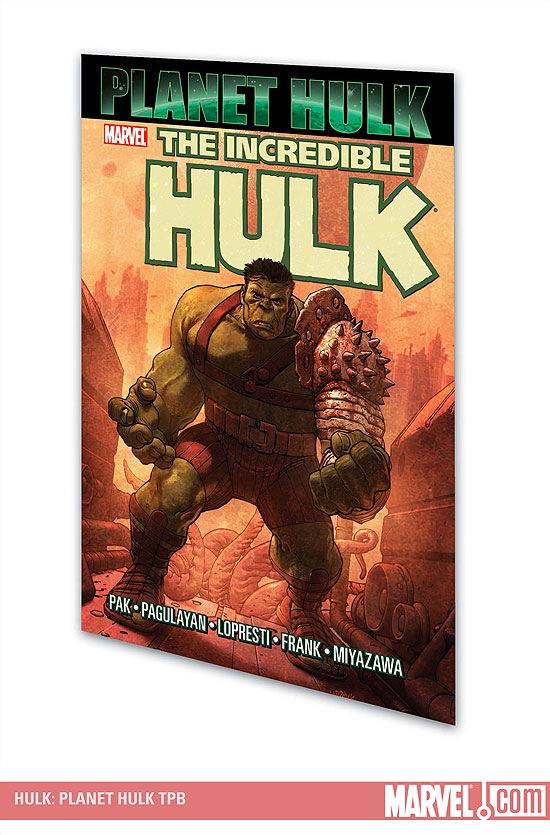
The Hulk trapped on an alien planet becoming a slave and eventually ruler of the planet! Cool monsters, gladiator fights, The Hulk with armor and a sword, all sorts of goodness was promised by the covers of the original comic issues. All of that is collected into this graphic novel.
The basic story is the betrayal of the Hulk by a group of fellow heroes. They shoot him into deep space supposedly to a planet with no intelligent life where he can live in peace. Something goes wrong. The Hulk's ship falls through a wormhole and crashes on a world of violence, the world of Sakaar.
Our hero is weakened by his trip through the wormhole and is enslaved by the soldiers of the Emperor. He begins to quickly regain his strength thanks to the constant hostile stimulants he receives. He eventually befriends a number of fellow gladiators and they begin to work on gaining their freedom. The group eventually swears an oath making them Warbound.
Eventually the Warbound are given a task to finally gain their freedom that they are unwilling to perform. Luckily the obedience disks implanted on them are destroyed and they are able easily fight through the imperial army to freedom. They begin attracting more and more followers as the Emperor tries to have them destroyed.
After a long struggle against the insane Emperor the Warbound are victorious and the Hulk is proclaimed the Green King. His feats during the conflict were amazing and topped anything he has done in the past. At one point he even plunged into the cracking crust of the planet and managed to pull it back together, saving the world! Now he was victorious. He was now King of an entire world and had a queen and even an offspring on the way. The citizens celebrated their new ruler, they did not fear him. And while wanting to be left alone he now has the responsibility to rule a world; and it seems he will grow to fill that obligation.
However more happens in the last few pages that set they next stage of the Hulk's story in motion. I never continued on to find out what happened next. I knew what would happen next. The Hulk would get screwed and would never get proper vengeance. No need for me to read any of the comics that came after this.
I was never regularly read the Hulk comics, but I loved this story. A misunderstood being who just wants to live in peace and freedom who is betrayed by his friends and continues to try to live his life as best he can under constant unwanted events.
A short story related to the main one is also included. Amadeus Cho is a young man and the seventh smartest person on Earth. He is also a real friend of the Hulk. I love how Cho puts the evil Reed Richards in his place for Richards' part in the Hulk's exile. He even shows how the world's 'heroes' are more dangerous to the Earth than the Hulk ever was. "And you have to wonder if there wouldn't be fewer dead folks out there in your little civil war if you'd launched yourselves into space instead of him."
Rounding out the book are great write ups about the planet Sakaar and its solar system. A history of the world and its inhabitants including a map and other great information. All in all a great addition to the collection of comic book fans.
Sorry if this was light on details. Just trying to avoid any more spoilers than necessary.
PUBLISHER: Marvel Publishing, Inc.
GENRE: Graphic Novel; Science Fiction/Fantasy
PAGE COUNT: 416
2012 CHALLENGES: 150+ Reading Challenge 2012, 2012 Graphic Novel Challenge
19 January 2012
Third Sentence Thursday - The Myth of the Great War
2. Share your thoughts on the sentence (or sentences).
3. Post a link on Proud Book Nerd's Third Sentence for the week by clicking on the image above.
4. Visit one or two of the other blogs to check out their third sentence(s).
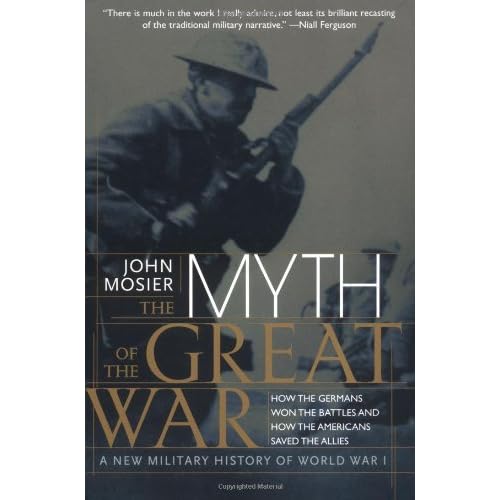
"The Russians had declared a preparatory or intermediate step toward completing mobilization on the twenty-sixth, followed by an order for a general mobilization on the twenty-ninth, which was canceled and then approved on the thirtieth." (from The Myth of the Great War by John Mosier)
I started this one today, I've read too much fiction that last couple weeks, back into World War One. The Russians seem to have fumbled a bit in their reaction to Austro-Hungary's partial mobilization against Serbia.
Russia wanted to intimidate Austria in an attempt to limit the Empire's vengeance against Serbia. They had trouble with a partial mobilization since their plans and time tables were geared for full mobilization. They didn't want to antagonize Germany, but the Germans were itching for a fight.
Not long after most of Europe was at war. A war that would draw in much of the world including Japan and the United States.
18 January 2012
Book Review - Tunnel Through Time

THE STORY
A scientist exploring the secrets of gravity accidentally invents a time machine. After making sure it would be safe to send humans back in time a paleontologist friend of his becomes the first time traveler. However something goes wrong and the man doesn't return.
At this point the main character, a seventeen-year old boy, and the son of the missing man go back eighty-million years in time to find the boy's father. Encounters with dinosaurs and other strange creatures result.
Eventually they accomplish their mission and prepare to return home. The only problem is that they have to take smaller steps to get back to 1966. A brief stop in the Ice Age and then another stop about 20,000 years ago where they encounter early humans.
THE CHARACTERS
Bob Miller - the narrator and main character. The 17-year old son of the inventor of the time machine. Bob is athletic and brave.
Pete - the son of Doc Tom, the paleontologist. He has his 18th birthday while 20,000 years in the past. Pete is a bit of a nerd, not much of the physical type. But he does pull his own weight during the adventure.
Doc Tom - Pete's father and the world's first time traveler.... unless you count the primitive girl that ended up briefly traveling to 1966. Technically she became the first time traveler 20,000 years before Doc Tom did. I kept reading his name as Doc Tomorrow... I was picturing him as some sort of pulp hero.
There was also Bob's father, some other scientists, and numerous primitive humans.
FINAL ANALYSIS
This was a younger reader title. It was a quick and interesting read. The pseudo-science they used sounded pretty good for 1966. They only problem I had with it was where the characters got into a battle with some of the natives 20,000 years ago and had to shoot a number of them. Seriously, when they returned to 1966 they would have ended up in a totally divergent universe form the massive changes resulting in the deaths of a dozen or more people that long ago at the dawn of humanity.
PUBLISHER: Scholastic Book Services; 1967 printing; copyright 1966 by Lester Del Rey
GENRE: Science Fiction; Time Travel
PAGE COUNT: 160
2012 CHALLENGES: 150+ Reading Challenge 2012, 2012 Read 52 Books in 52 weeks, 2012 A-Z Book Challenge, 2012 TBR Pile Reading Challenge
14 January 2012
Book Review - The Divide

THE STORY
It is 1976. Two-hundred years since the Declaration of Independence and thirty years since the United States surrendered to the Axis. The elderly Hitler and Tojo plan a historic meeting in the center of America at a place they call the Divide. America has been a peaceful place for a number of years, no real uprisings, citizens being willing slaves to their German and Japanese masters. All that is about to change.
A number of people get involved in setting the stage for a new American Revolution. It starts with the bizarre assassination of a Japanese general on the Fourth of July. The story then jumps between various characters - the trio of freedom fighters and their interactions with other rebel elements, an SS officer tasked with destroying the resistance, and other people whose lives are touched by the ongoing events.
Pieces start to fall in place and all of the threads lead to the meeting of the two rulers at the Divide. There are plenty of set-backs and a few twists and turns along the way.
Overgard's style is interesting. There is a tendency to introduce new information and then spend a few pages telling the back-story of that new information, usually in the form of flashbacks. While this works in most cases, there were a couple of times I wished he would shorten some of the flashbacks and keep going with the events in the 'present'.
THE CHARACTERS
The Old Man (Wayne Stubbs) is the main character of the story. He has a checkered past involving accidentally injuring a prostitute, indirectly causing his wife to commit suicide, and then wounding another prostitute in an attempt to kill her while suffering the rage and despair following his wife's death. He then fled to Canada and eventually made his way back after America fell to the Axis. Not the most heroic of backgrounds but he now feels he has to make up for the past by saving the country's future.
The Cowboy (Cooper): This young man was raised by The Old Man. He was raised to be a hero and to be an inspiration for others in the coming revolution. He plays his role well but gets caught up in his first real encounters with women (he and The Old Man lived a very isolated and hobo-like lifestyle).
Claus Dieter is the antagonist from the SS. He is on the trail of the heroes after the July 4th assassination. He is an evil and deceitful man who, while smart, is usually in over his head. He tries to destroy the resistance while keeping his superiors from getting rid of him for any failures.
In addition there are numerous other characters, an Amerind girl, a Jewish woman who is putting the finishing touches on her father's bomb, and many others. Most of the characters are interesting and the liberal use of flashbacks in the novel gives us all the information we need about them.
FINAL ANALYSIS
A great story overall. I have mentioned the sometimes annoying use of flashbacks, but there were only a couple of places that this really bothered me. The ending, while it wrapped up the main story, did not reveal the eventual results of the new Revolution. In fact the last page was about Hitler's daughter being pregnant. I'm not sure if this was to set up a sequel or just to establish that history keeps chugging along, even after some really historic events take place.
As with life, there are not happy endings, just another day and new challenges following the last.
PUBLISHER: Jove Publications, Inc.; copyright 1980 by William Overgard
GENRE: Alternate History
PAGE COUNT: 244
ISBN: 0-515-05492-5
2012 CHALLENGES: 150+ Reading Challenge 2012, 2012 Read 52 Books in 52 weeks, 2012 A-Z Book Challenge, 2012 TBR Pile Reading Challenge, The 2012 TBR Pile Challenge
12 January 2012
Third Sentence Thrusday - The Divide
Sounds like the Japanese military is on the move. Someone important, like a general, given the Toyota limo with the pennants.
Of course, looking at the cover these vehicles are probably moving somewhere across the western United States. I wonder what they are up to and how the Germans and American resistance will respond.
05 January 2012
Third Sentence Thursday #12
This was the third sentence in the Foreword. It was part of the first person narration of the main character, Lord Grandrith. Normally when I hear the year 1888 my mind jumps to one thing. Despite all of the events that took place in 1888; The founding of the National Geographic Society, the Washington Monument opening to the public, Susan B. Anthony organizing a Congress for Women's Rights, George Eastman's patent on a camera that uses film rolls, the crowing of Wilhelm II as the Emperor of Germany, and countless other events of that year.
No, the first thing I think of hearing 1888 is Jack the Ripper.
This time my instincts would be right. The fourth sentence of the Foreword is: "Jack the Ripper was my father."
02 January 2012
Book Review - A Feast Unknown
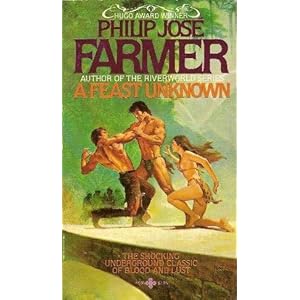
I've finished reading my first book for 2012. I decided to start the years off with Philip José Farmer. I grabbed one of his books off my shelf that I had yet to read and picked A Feast Unknown. This book is certainly for adults only.

(image from Amazon.com)
While much of Farmer's writings touch on sexuality this book was at times a bit over the top on the subject. It is told first person by Lord Grandrith, an English lord who was raised by apes in Africa from the age of 1. Basically he is the real person behind Burrough's Tarzan series. Grandrith is attacked and hunted by the Kenyan military, Albanian mercenaries, and Doc Caliban (who was the 'real' person which the Doc Savage pulps were based on).
To the Grandrith's shock he finds that violence and death now cause sexual excitement and release while actual sexual activity does not arouse him any longer. Something similar is happening to Doc Caliban.
Behind it all are the mysterious Nine. A group of near immortal beings that control the world. Both Grandrith and Caliban are servants of the Nine and have their lives extended well beyond normal. Now the Nine are manipulating the two into conflict.
I won't go into details here, but many things are touched on during the story; infidelity, rape, incest, bestiality, homosexuality, and the general linking of sex and violence being experienced by the main character as I mentioned above. It is well written but if you are uncomfortable with such topics you may want to stay clear of this book. It is also clear that this book was written in the sixties.
The story leads all the characters to Grandrith's estates in England (well, all except the Kenyan military, I don't think they got through customs). A battle of a pretty large scale takes place between the various factions. After that Grandrith and Caliban battle each other for the right to fill an open seat in the Nine.
This book is not part of Farmer's Wold Newton universe. In this both Grandrith and Caliban are revealed to be children of Jack the Ripper which certainly does not fit the family trees created in Tarzan Alive and Doc Savage: His Apocalyptic Life.
Overall I enjoyed this book. Nearly non-stop action. At times the violence was a bit silly, and Lord Grandrith's uninhibited descriptions of various sexual topics was uncomfortable at times the story was, in total, interesting. While I haven't decided what scale to use for rating all the books I plan to review this year I'll just go with a six out of ten for it.
PUBLISHER: PEI Books, Inc. Copyright 1969 Philip José Farmer, cover copyright 1980 PEI books, inc.
GENRE: Science-Fiction, Adventure
PAGE COUNT: 288
ISBN: 0-872-16586-8
2012 CHALLENGES: 150+ Reading Challenge 2012, 2012 Read 52 Books in 52 weeks, Read Your Name 2012, 2012 A-Z Book Challenge, 2012 TBR Pile Reading Challenge, The 2012 TBR Pile Challenge
While much of Farmer's writings touch on sexuality this book was at times a bit over the top on the subject. It is told first person by Lord Grandrith, an English lord who was raised by apes in Africa from the age of 1. Basically he is the real person behind Burrough's Tarzan series. Grandrith is attacked and hunted by the Kenyan military, Albanian mercenaries, and Doc Caliban (who was the 'real' person which the Doc Savage pulps were based on).
To the Grandrith's shock he finds that violence and death now cause sexual excitement and release while actual sexual activity does not arouse him any longer. Something similar is happening to Doc Caliban.
Behind it all are the mysterious Nine. A group of near immortal beings that control the world. Both Grandrith and Caliban are servants of the Nine and have their lives extended well beyond normal. Now the Nine are manipulating the two into conflict.
I won't go into details here, but many things are touched on during the story; infidelity, rape, incest, bestiality, homosexuality, and the general linking of sex and violence being experienced by the main character as I mentioned above. It is well written but if you are uncomfortable with such topics you may want to stay clear of this book. It is also clear that this book was written in the sixties.
The story leads all the characters to Grandrith's estates in England (well, all except the Kenyan military, I don't think they got through customs). A battle of a pretty large scale takes place between the various factions. After that Grandrith and Caliban battle each other for the right to fill an open seat in the Nine.
This book is not part of Farmer's Wold Newton universe. In this both Grandrith and Caliban are revealed to be children of Jack the Ripper which certainly does not fit the family trees created in Tarzan Alive and Doc Savage: His Apocalyptic Life.
Overall I enjoyed this book. Nearly non-stop action. At times the violence was a bit silly, and Lord Grandrith's uninhibited descriptions of various sexual topics was uncomfortable at times the story was, in total, interesting. While I haven't decided what scale to use for rating all the books I plan to review this year I'll just go with a six out of ten for it.
PUBLISHER: PEI Books, Inc. Copyright 1969 Philip José Farmer, cover copyright 1980 PEI books, inc.
GENRE: Science-Fiction, Adventure
PAGE COUNT: 288
ISBN: 0-872-16586-8
2012 CHALLENGES: 150+ Reading Challenge 2012, 2012 Read 52 Books in 52 weeks, Read Your Name 2012, 2012 A-Z Book Challenge, 2012 TBR Pile Reading Challenge, The 2012 TBR Pile Challenge
Subscribe to:
Posts (Atom)
